Some of S-B's Sponsors
Use Menu to Navigate: I gotta get me one of THESE!
Looking
to post an article or review?
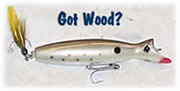
Got Wood? Another project for around the house where you can build your own custom wooden lures, pour you own soft-baits or jigs... Support your local fishing clubs and tackle shops! Is your club interested in affiliation with Striped-Bass.Com? Drop us a line... webmaster Copyright © Striped-Bass.Com 1999-2005 please forward comments to webmaster Need a website or Interested in becoming a sponsor to Striped-Bass.Com? We have limited spaces available, contact me @ john@striped-bass.com back to Striped-Bass.com
|
|
|
|
Updates to Striped Bass section of Wikipedia by John Redmond and the Striped-Bass.com Wiki Team East Coast striped bass are typically found from the Carolinas to Nova Scotia. Their primary migratory range is from the Carolinas to New York's Hudson River in the winter time and from New Jersey through Maine in summertime with the greatest concentration between Long Island, New York, Rhode Island, and Massachusetts. The migration north often begins in March for juvenile fish and April / May for adult fish. The migration south often begins in September from areas in Maine.
Fishing Rhode Island: Rhode Island anglers can often expect to find the first fresh run Striped Bass in the waters off Matunuck, Newport, and Westerly in late March to early April. Some of the fish may be mixed in with a local fish population that spends winter without migrating to the primary wintering grounds off of Maryland, Virginia, and North Carolina. These early fish are often of the smallest migrating size class, often called "schoolies" or "school bass" and typically range from 6 inches to the mid-twenty inch range. Popular places to catch these early season fish in Rhode Island include Matunuck, Charlestown, Narragansett, and Newport. May through July will present the arrival of larger fish, often referred to as "keepers" in that they can legally be kept for personal consumption if over 28 inches from tip of head to tip of tail (regulation as of 2005) with a maximum of 2 kept per day. Also as May turns thru June the best time to catch these larger bass for the shore angler will typically move from daytime to nighttime. “Schoolie” and “Keeper” sized striped bass can be typically found along the entire shoreline of Rhode Island from April through October with some places holding fish year round. In September, the striped bass prepare for their migration south to their wintering areas. The “Fall Run” as it is called along the coast can account for some of the best fishing of the year for larger fish. The largest fish, including those considered Trophy fish and exceeding forty pounds, are most often found in September and October. Popular fishing areas in the Fall Run include the beaches and rocky shoreline of Newport, Narragansett, the breachways of Charlestown, and Westerly. Popular Striped Bass fishing clubs include the Newport County Saltwater fishing Club and the Rhode Island Saltwater Angler’s Association (http://risaa.org).
Fishing Massachusetts: Massachusetts anglers have access to numerous types of fishing from sandy beaches to rocky ledges along the shore to flats and deep water when accessed from a boat. Like Rhode Island, the first fish of the year tend to show in early April along the southcoast and Cape Cod with the season following a similar pattern with the majority of fish leaving, north to south, in October. Practically the entire coast of Massachusetts contains fine areas to fish for striped bass wherever you can legally access the shoreline. As with all coastal states, federal law requires when fishing for striped bass from a boat that you stay within three miles of land. Popular Massachusetts destinations for striped bass fishing include Cape Cod, Martha’s Vineyard, Boston Harbor, and Plum Island. Fishing Tournaments for Striped Bass are very popular in Massachusetts with one of the oldest and most popular being the Martha’s Vineyard Striped Bass and Bluefish Derby. In 2005, the 60 th Annual “MV Derby” brought several thousand visitors to the island together with over a thousand local participants for the month long “ Derby” from mid September to mid October. In 2005, the largest Striped Bass from shore during the Derby was caught by Leo Lecuyler, weighed over 45 pounds, and won Leo a new Boston Whaler boat. The largest boat caught striped bass of the derby at 49.22 pounds, and was caught by Martha’s Vineyard Islander, 12 year old Molly Fischer. Popular Striped Bass fishing clubs include the Massachusetts Striped Bass Association (http://msba.net) and the Cape Cod Salties.
Surfcasting: The most popular method for fishing for striped bass based on number of anglers is shore fishing as many anglers may not have access to a boat or simply preference. Shore fishing can include fishing the shores of inland waterways, saltwater ponds, rivers, and bays. Various methods of light tackle to heavy gear can be used. More challenging shore fishing along the immediate coastline is often referred to as Surfcasting and the anglers as Surfcasters. Surfcasters typically gear up a little differently than inshore shore anglers as the conditions tend to be more severe. Surfcasting conditions can often include high wave conditions, heavier winds, and a deluge of breaking waves, or “surf”, on the angler and angler’s equipment. In addition to rod, reel, and tackle, the surfcaster’s typical equipment list will include items for safety and for comfort such as waders, secured by a tight wader belt to prevent filling with water, dry top, line clippers, pliers, hook cutters, and knife as well as a neck light or headlight for use (sparingly) at night. Additional items for safety may include an inflatable life vest to prevent drowning accidents in more severe conditions (several fatalities along the east coast occur yearly when surfcasting) and steel studded soles attached to wader boots to improve traction when standing on slippery, weed covered rocks or jetties. More extreme surfcasting may entail climbing on rocks far from shore to gain an advantaged position or in some cases; anglers may don wetsuits to swim to rocks in water unreachable by wading. Gear used in Surfcasting tends to favor spinning or conventional reels on rods in the 8 – 10 foot range using lines of 15 – 30 pound test monofilament or equivalent diameters of braid. At the end of this line one will typically find wooden, plastic, or metal lures, or perhaps some fishing a live American Eel like one would fish a lure. Plastics lures are the most popular but the traditional methods of wooden lures are still very popular.
In recent years, there has been an upsurge in the use of custom gear, including hand made “Custom Wooden Lures” and “Custom Built Surf Rods”. Both of these custom tailored markets are able to satisfy very specific needs when surfcasting for striped bass.
|
||